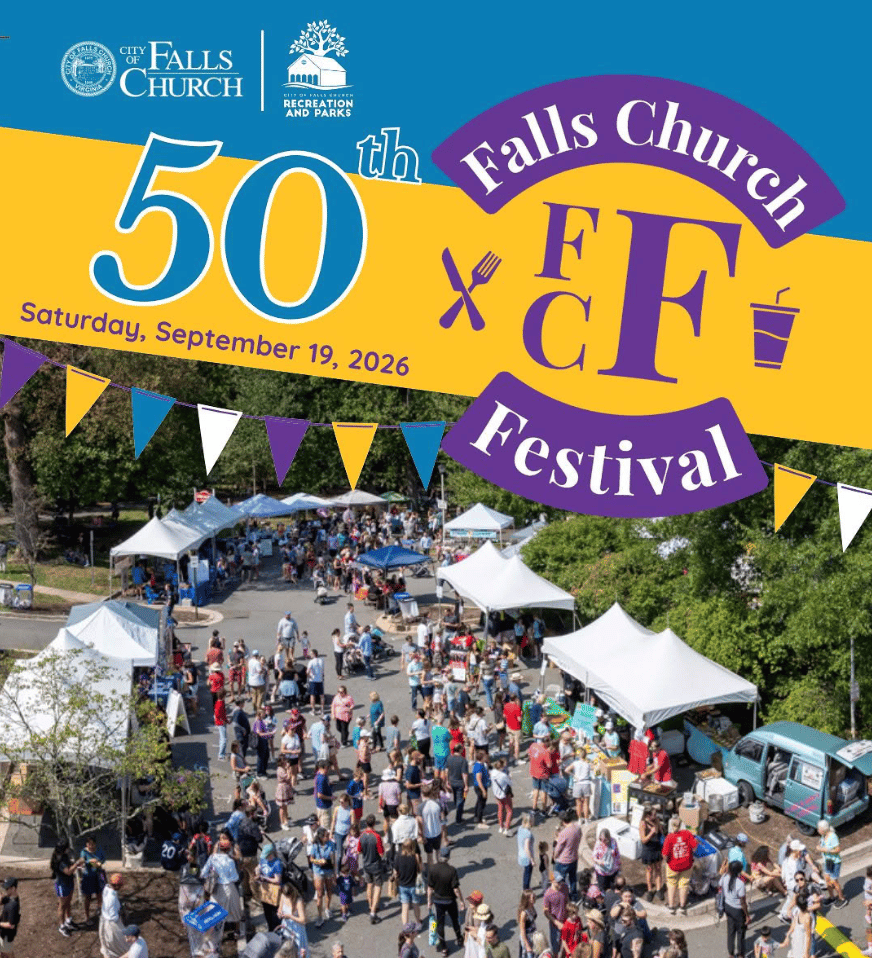
If you have heard about Falls Church City you know the Fall Festival or what used to be called the taste of Falls Church is a BIG event in this little town! Little Falls Street closed to two-way traffic at 7 a.m. on September 19. If you live within a few blocks of Park Avenue, you already know this because you've seen the barricades go up before, more Septembers than you can probably count. What you might not know is that this particular Saturday marked the festival's fiftieth year: Little Falls Street closed, the beer garden poured, pony rides were offered, and local restaurants served small bites for a few dollars in tickets.
Fifty years is a long time for anything to survive in a place with 2.2 square miles to work with. That's not incidental to the story. It's the story.
The Same Corner, Every September
The 50th Annual Falls Church Festival and Taste of Falls Church ran from 10 a.m. to 4 p.m. on the grounds around the Community Center at 223 Little Falls Street, with the beer garden pouring from 11 a.m. to 3:45 p.m. Rain or shine, admission is free, and the festival's own math is simple: three dollars per taste, one or two tickets per item.
This year eighteen local businesses were behind the Taste tables, including Cafe Kindred, Clare and Don's Beach Shack, and Fish Taco. The city ran a milestone-year scavenger hunt across the grounds, and taste ticket presales opened Monday, September 14, at the Community Center, card or exact change only. If you drove in, Little Falls Street between Park Avenue and Great Falls Street closed to two-way traffic until noon, then opened to one-way inbound traffic from Great Falls Street, then reopened fully after the festival wrapped. Side streets and the Kaiser Permanente garage were your parking options. Accessible parking was on Great Falls Street.
None of that is complicated. What's harder to explain is how a volunteer-dependent street festival in a city government's parks and recreation calendar has run for half a century without lapsing.
A City That Fits in Your Pocket
Falls Church City covers 2.2 square miles. That makes it one of the two geographically smallest independent cities in Virginia, home to somewhere between 14,000 and 15,000 people depending on which recent count you trust. It has its own government, its own school system, and its own police department, all packed into a footprint you could walk end to end in under an hour.
That size usually reads as a limitation. Here it works the other way. Falls Church Mayor Letty Hardi has written about the city's push toward what urban planners call a 15-minute city, where most daily needs sit within a short walk or bike ride, and noted that roughly 70 percent of residents already live within a 10-minute walk of a grocery store. The same geography that puts a grocery store close to everyone also puts the festival grounds, the farmers market, and Cherry Hill Park within a few blocks of most front doors.
A festival that depends on volunteers, sponsors, and foot traffic has an easier time reaching fifty years when the entire potential audience lives inside a two-mile radius. Distance isn't the obstacle it would be in a sprawling county. It's the reason the same faces can show up year after year without much effort.
Fifty Years and Going Strong
A tradition that runs half a century without changing usually isn't a tradition anyone still shows up for. The Falls Church Festival has kept adjusting itself in ways that are easy to miss if you've only attended the last few.
The beer garden wasn't part of the original event. It was added in 2016, a full four decades into the festival's run, and has since become one of its bigger draws, funded in part through a rotating nonprofit beneficiary program that hands 30 percent of beer garden sales to a different City of Falls Church nonprofit each year. This year's outdoor Taste Ticket booths also moved, sitting in front of the Community Center for the first time, a small logistical shift but a real one, the kind of adjustment an event only bothers making if it still cares about how the day actually flows for the people attending it.
Fifty years in, the festival is still willing to rearrange its own floor plan. That's a different thing than simply repeating itself.
The Rest of the Calendar Doesn't Slow Down Either
The festival isn't an isolated weekend. It sits inside a four-week stretch where the city's parks and recreation calendar barely lets up, all of it within walking distance of the same handful of blocks downtown.
- September 19: 50th Annual Falls Church Festival and Taste of Falls Church, Community Center grounds, 10 a.m. to 4 p.m.
- September 25: Sunset Cinema at Cherry Hill Park, the 23rd year of the series, screening Hoppers at 7:15 p.m.
- October 3: Fall Recycling Extravaganza and Fall Community Clean Up
- October 10: Farm Day at Cherry Hill Farmhouse, with historic trades demonstrations, a petting farm, pony rides, pumpkin painting, and live music
- October 16: The final Sunset Cinema of the season, closing with Jumanji at 6:45 p.m.
Sunset Cinema draws food trucks to the park for each screening, past lineups have included Mo's Fried Chicken and Smash Burgers, Kaziville, and Mr. Flavors for ice cream and sweets, and the whole series runs on a simple setup: bring a blanket, arrive early for a spot near the barn and playground, and expect the movie to start at dusk. Farm Day leans into the same site's actual history, since Cherry Hill Farmhouse still has its 1856 barn standing on the property, used to teach kids what a working farm on this land once looked like.
Underneath all of it sits the Falls Church Farmers Market, open every Saturday, year-round, in the City Hall parking lot. It doesn't pause for festival season. It just keeps running the same morning shift it always has, which is easy to do when your regular customers already live close enough to walk over on festival morning.
What a Tight Footprint Actually Buys You
None of this is really about programming calendars. It's about what a small, walkable city can sustain that a sprawling one often can't. Fifty consecutive years of the same street festival requires a volunteer base that doesn't burn out, a business community willing to keep showing up with taste tickets and sponsorships, and a population dense enough that word of mouth still works better than advertising. Falls Church City has all three because its size forces them to stay connected. You run into the same neighbors at the farmers market, the same restaurant owners at the festival, the same families at Sunset Cinema, because there's genuinely nowhere else in a 2.2-square-mile city for any of you to be.
That's the part worth sitting with if you already live here. The Little City nickname sounds like it's describing a limitation. What it's actually describing is the mechanism that keeps fifty years of the same Saturday in September worth showing up for.
If you're weighing a move within the Little City, thinking about what your own street looks like on festival weekend, or just want to talk through what's changing block by block this fall, Kelly Millspaugh Thompson has spent her whole life in Falls Church and is always up for that conversation. Let's Connect.